The Gen X Hormone Shift

Owning the Mid-Life Mindf**k
You’re 48. You’re at the peak of your career, you’ve raised decent humans, you’ve survived dial-up, the dot-com bust, and a housing market crash. You are, by any measure, a resilient, cynical, self-reliant member of Generation X. You are a survivor.
So why do you feel like you’re losing your damn mind?
For women, it’s the sudden rage that boils over in a traffic jam, the brain fog that makes you forget a common word, or the anxiety that wakes you up at 3 AM with a heart full of dread. For men, it’s a creeping apathy, a loss of the competitive fire that once drove you, a gray-tinted world where nothing feels exciting and your own ambition seems like a distant memory.
You chalk it up to stress. To burnout. To being a part of the "Sandwich Generation." But the truth is far more primal. Your body's core operating system is getting a massive, unasked-for software update, and nobody gave you the manual.
Welcome to the great hormonal shift of mid-life: menopause and andropause. And for Gen X, this biological rite of passage is a particular kind of mindf**k. We were raised by a generation that never talked about this, conditioned to “suck it up,” and now we’re hitting a wall of anxiety, depression, and identity crisis that can’t be fixed with a perfectly curated mixtape or ironic detachment.
It’s time to stop toughing it out in silence. This isn’t the end of your life; it’s the end of the life you knew. The key is to understand the battle you’re in, so you can stop being its victim and start being its commander.

What the Hell Is Happening to Me? The Biological Breakdown
This isn’t just in your head. It is a profound physiological event. Your brain is a finely tuned machine that runs on hormones, and for decades, you had a steady, predictable supply. Now, the supply chain is chaotic.
For Gen X Women: Perimenopause and Menopause Are More Than Hot Flashes
The conversation around menopause is criminally simplistic. It's not just about your period stopping. The decade before that, known as perimenopause, is when the chaos truly begins. Your ovaries, the primary producers of estrogen, start sputtering. This is critical because estrogen isn't just for making babies; it's a master regulator for your brain. It directly impacts serotonin (your "happy" neurotransmitter) and dopamine (your "motivation" neurotransmitter).
As estrogen levels fluctuate and decline, so does your mental stability. A 2020 meta-analysis in the Journal of the American Medical Association (JAMA) confirmed a significant increase in the risk of depressive symptoms during the menopausal transition. What does this feel like?
Brain Fog: The inability to grasp words, remember names, or think clearly. This isn't early-onset dementia; it's your brain working with a fluctuating fuel supply.
Anxiety and Panic Attacks: A feeling of impending doom or a racing heart out of nowhere. This is often linked to the drop in progesterone, a hormone with calming, anti-anxiety effects.
Rage and Irritability: That "zero to sixty" anger? It’s often your brain’s response to low serotonin and the frustration of feeling out of control in your own body.
Loss of Self: A feeling of flatness or a loss of your own identity. The things that used to excite you now feel meaningless.
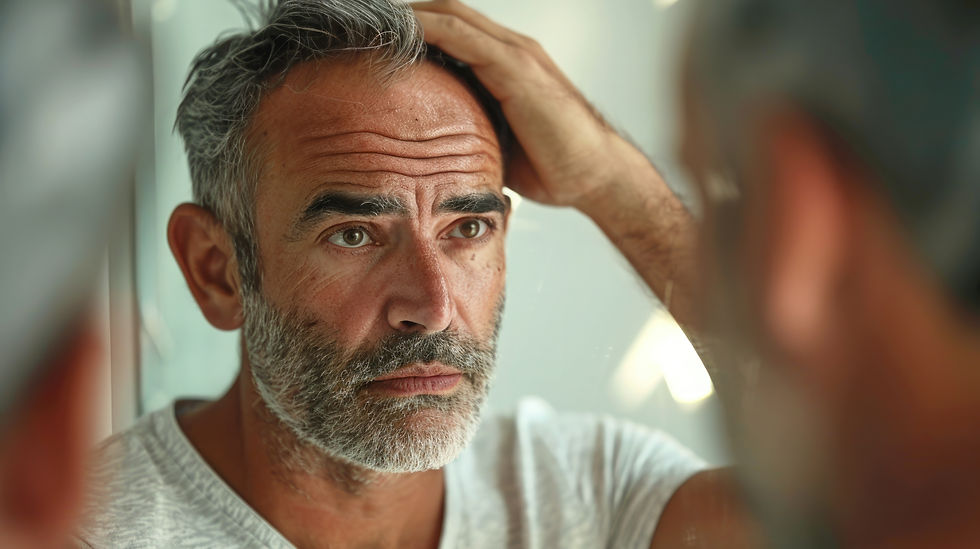
For Gen X Men: Andropause Is More Than "Low T"
For men, the hormonal shift is typically more gradual but no less significant. "Andropause," or late-onset hypogonadism, is the slow, steady decline of testosterone production that starts in your 30s and becomes more pronounced in your late 40s and 50s.
We associate testosterone with muscles and sex drive, but it's also a powerful driver of mood, motivation, and cognitive function. As levels decline, many men experience a distinct set of mental and emotional symptoms they mistake for simple burnout or a midlife crisis. Research published in The World Journal of Biological Psychiatry has shown a clear link between low testosterone levels and a higher incidence of major depressive disorder in men.
Apathy and Low Motivation: A creeping "what's the point?" feeling. The competitive edge you had at work feels dull. You’d rather watch TV than work on that project.
Irritability: A shorter fuse, a tendency to be grumpy or cynical.
Mental Fatigue: Similar to women’s brain fog, this is a feeling of being mentally slow or having difficulty concentrating.
Loss of Confidence: A general decline in your sense of vitality and power, which can lead to feelings of inadequacy.
For both men and women of Generation X, this isn’t just a physical annoyance. It is a direct assault on the identities we’ve spent a lifetime building: as competent professionals, as stable partners, as people in control.
The Gen X Blind Side: Why We Were So Unprepared
Our parents, the Silent Generation, treated these topics with a Victorian-era stoicism. You didn't talk about hormones, periods, or feelings. You certainly didn’t talk about losing your libido or feeling depressed. As latchkey kids, we were raised to be self-sufficient and to figure things out on our own. So now, when faced with this internal mutiny, our default programming is to just try and muscle through it alone.
This is a strategy doomed to fail. You cannot tough out a hormonal deficiency. You cannot fix a neurotransmitter imbalance with gritty resolve. You have to switch from a mindset of endurance to one of active, strategic management.
Your Action Plan for Owning the Shift
You are not a victim of your biology. You are the CEO of your own health. It’s time to step into that role with authority.
1. Demand Better From Your Doctor. Your first step is to get real data. "This is just part of aging" is not an acceptable diagnosis.
For Women: Find a NAMS-certified menopause practitioner (menopause.org). Track your symptoms. Ask for a full hormone panel and discuss the current, evidence-based options for Hormone Replacement Therapy (HRT), which for most healthy women are considered safe and highly effective.
For Men: Go to your PCP or a urologist and ask for your testosterone levels to be checked (specifically "free" and "total" testosterone). Don't let them just tell you if you're in the "normal" range; that range is ridiculously wide. If you're a 50-year-old with the testosterone level of an 85-year-old, that's not optimal. Discuss your options, including Testosterone Replacement Therapy (TRT).
The Bottom Line: Be a proactive, informed patient. You are the expert on your own symptoms.
2. Master Your Lifestyle Levers Hormone therapy can be a game-changer, but it works best when combined with a foundation of disciplined self-care.
Lift Heavy Things: Strength training is non-negotiable. For both men and women, it is the single best way to fight age-related muscle loss, boost metabolism, improve bone density, and regulate mood. A 2018 study on older adults found that resistance training significantly reduced depressive symptoms.
Prioritize Protein and Control Blood Sugar: Hormonal fluctuations wreak havoc on your blood sugar, which in turn causes mood swings and fatigue. Build every meal around a solid source of protein to promote satiety, preserve muscle, and keep your energy stable.
Weaponize Your Sleep: Treat your bedtime with the same seriousness as a board meeting. Hormonal changes disrupt sleep architecture. You must fight back with a disciplined routine: a cool, dark room; no screens an hour before bed; and a consistent sleep/wake time.
3. Have the "Courageous Conversation." Your hormonal shift isn't just happening to you; it's affecting your relationship, too. The mood swings, the low libido, the communication breakdowns—they create distance. You have to get on the same team.
Action Step: Schedule a time to talk, away from distractions. Don't spring it on them. Use the framework in our Courageous Conversations Workbook to explain what you're experiencing, not as an accusation, but as a shared problem. "I feel distant from you when I have no energy or desire for intimacy. It’s not about you; it's about what I'm going through biologically. I need us to figure this out together."
4. Re-evaluate Your "Why" For many in Gen X, this biological shift forces a psychological one. The loss of the drive that fueled your career or the end of your primary parenting role can feel like a loss of purpose. This is not a crisis; it is an invitation.
Action Step: This is the perfect time to do a deep, honest audit of your life. Use our Values Clarification Workbook to figure out what actually matters to you now, not the you from 20 years ago. Maybe achievement is less important now than connection. Maybe stability is less important than freedom. This hormonal shift gives you the opportunity to design the second half of your life with intention, based on the wisdom you've earned.
This chapter of your life is not about decline. It's about recalibration. The stoicism and self-reliance that defined you as a Gen Xer are still your assets, but they need to be aimed in a new direction: toward a radical, unapologetic, and strategic ownership of your own well-being. Get the data, make a plan, and execute. You've been doing it your whole life. This is just the next level.
If you could use a little extra support navigating this mid-life mind f*ck, reach out today! Our expert therapists are here to help!
References:
Gordon, J. L., Girdler, S. S., Meltzer-Brody, S. E., Stika, C. S., Thurston, R. C., Clark, C. T., ... & Freeman, M. P. (2020). Ovarian Hormone Fluctuation, Neurotransmitters, and Mental Health. JAMA Psychiatry, 77(9), 967–968.
Khera, M. (2016). Male Hormones and Men's Quality of Life. The World Journal of Biological Psychiatry, 17(S1), 2-3.
The North American Menopause Society (NAMS). (2022). The 2022 Hormone Therapy Position Statement of The North American Menopause Society. Menopause, 29(7), 767-794.
Gordon, B. R., McDowell, C. P., Hallgren, M., Meyer, J. D., Lyons, M., & Herring, M. P. (2018). Association of Efficacy of Resistance Exercise Training With Depressive Symptoms: Meta-analysis and Meta-regression Analysis of Randomized Clinical Trials. JAMA Psychiatry, 75(6), 565–576.
Avis, N. E., Crawford, S. L., & Greendale, G. (2015). The Study of Women's Health Across the Nation (SWAN): a multi-center, multi-ethnic, community-based cohort study of midlife women. In The Women's Health Initiative. Springer, New York, NY.


Comments